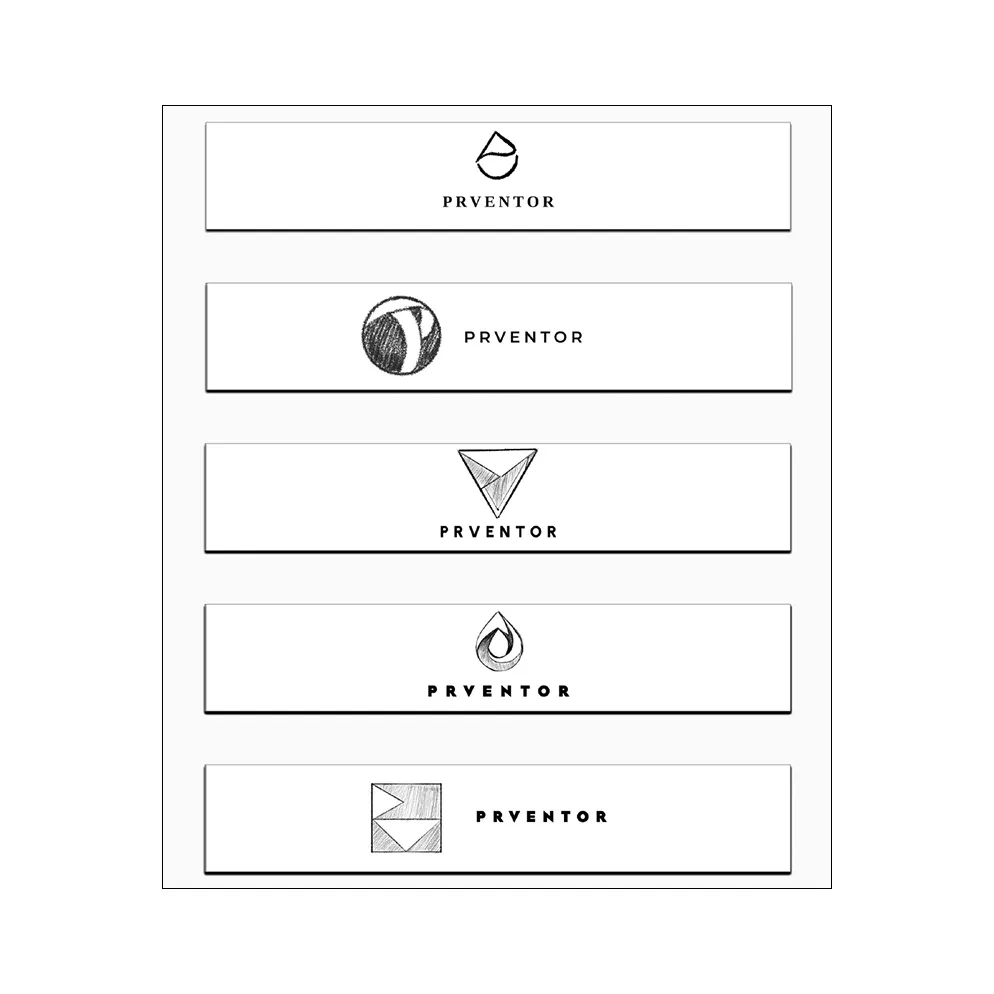
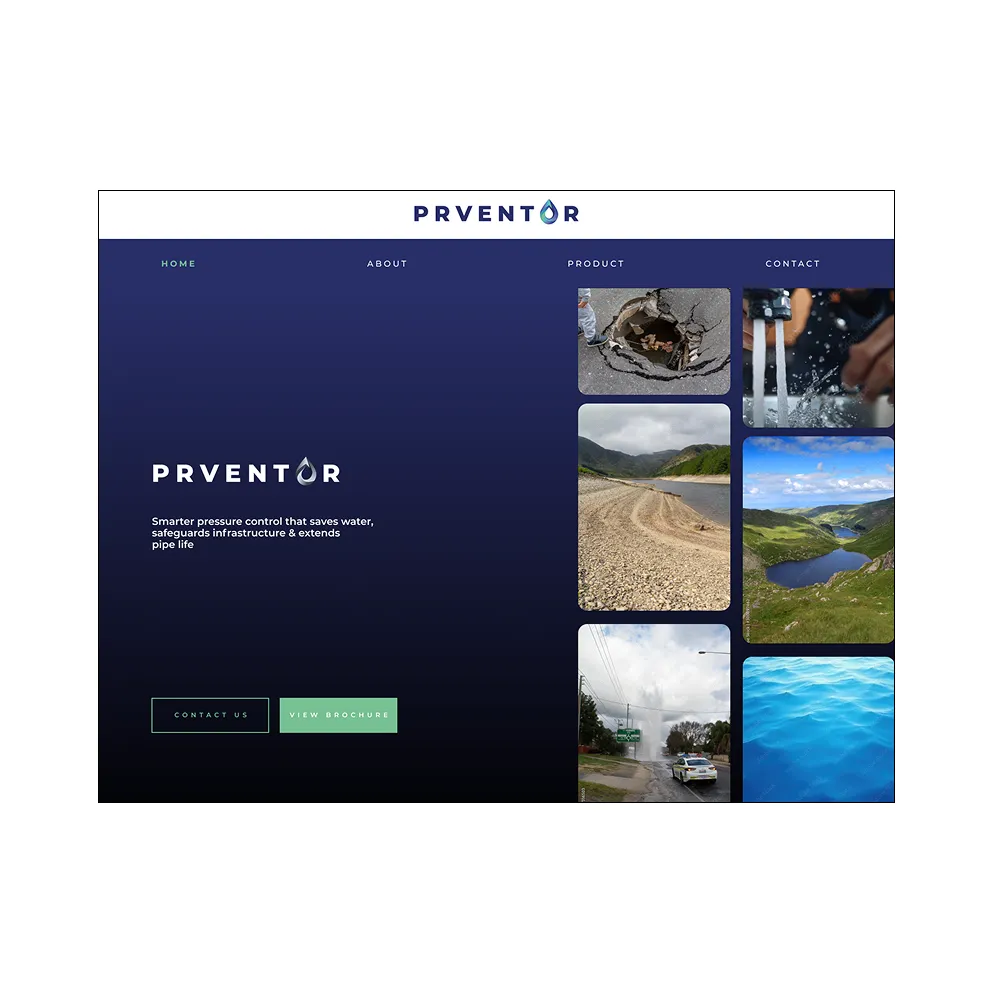
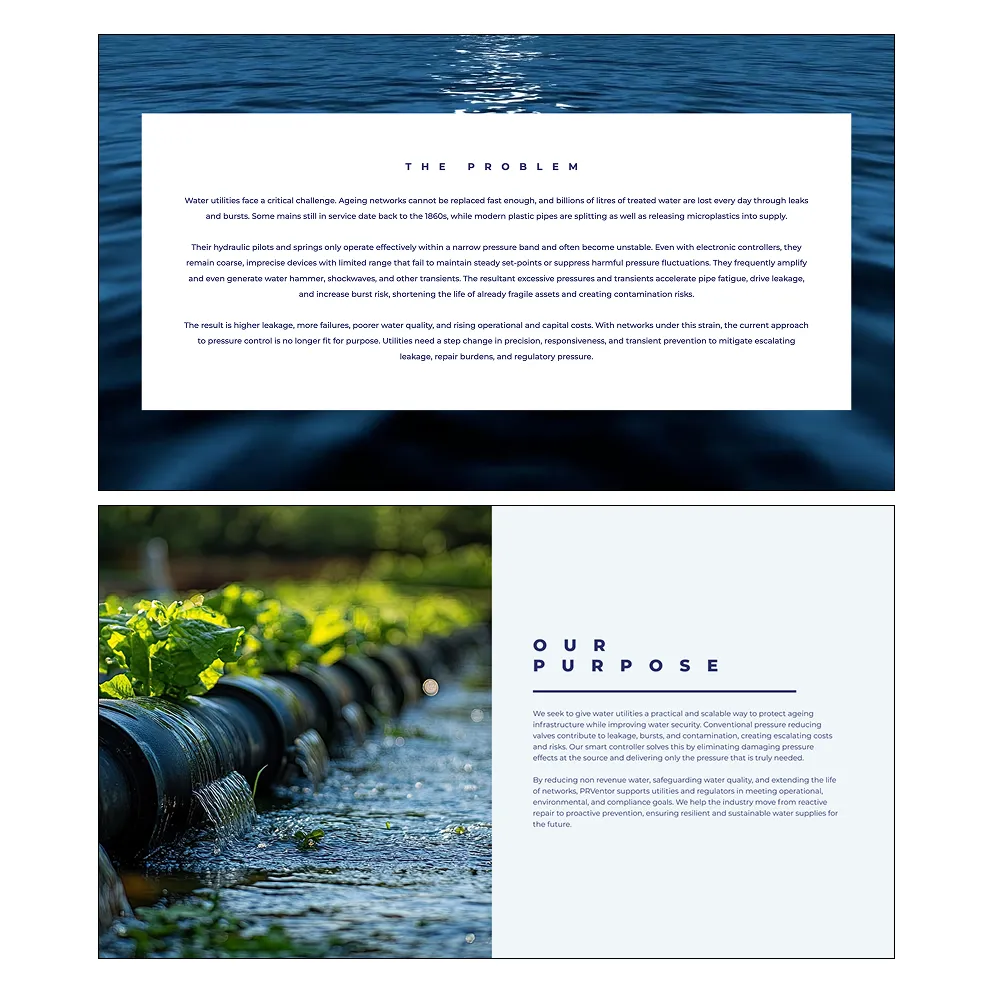
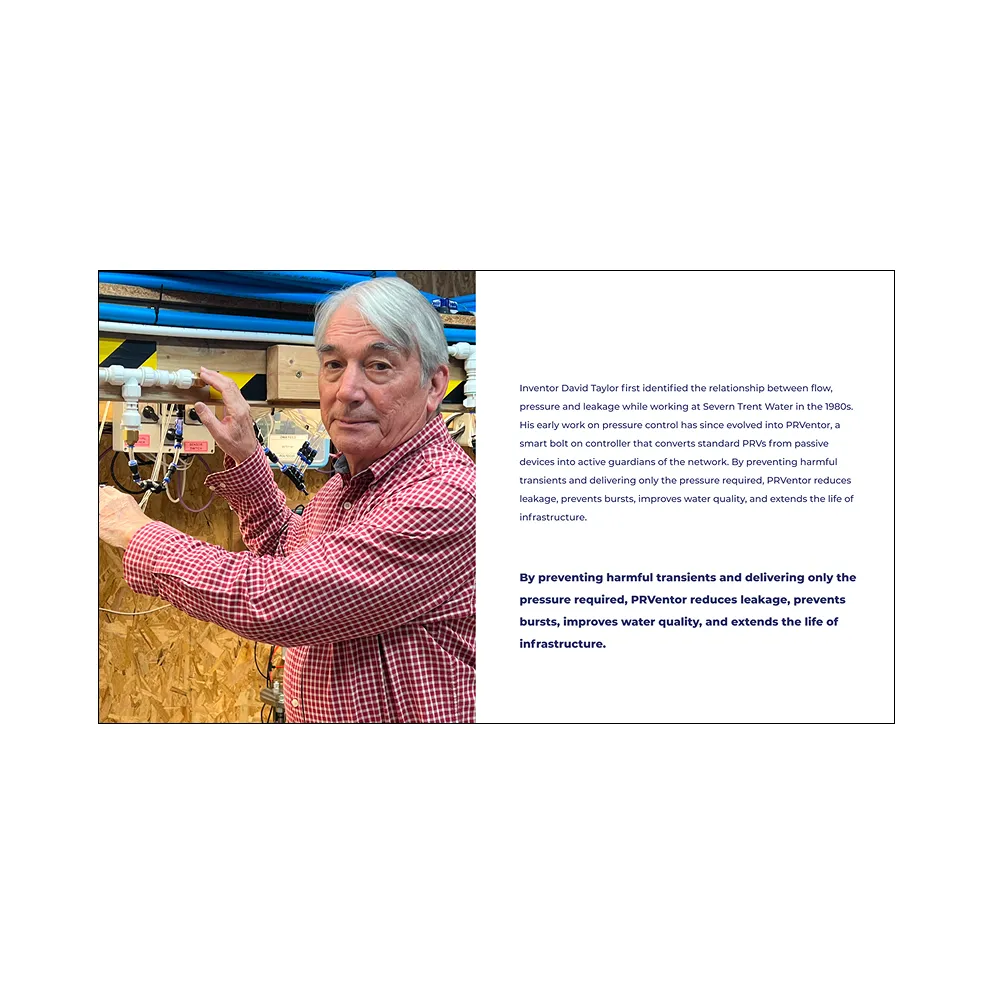
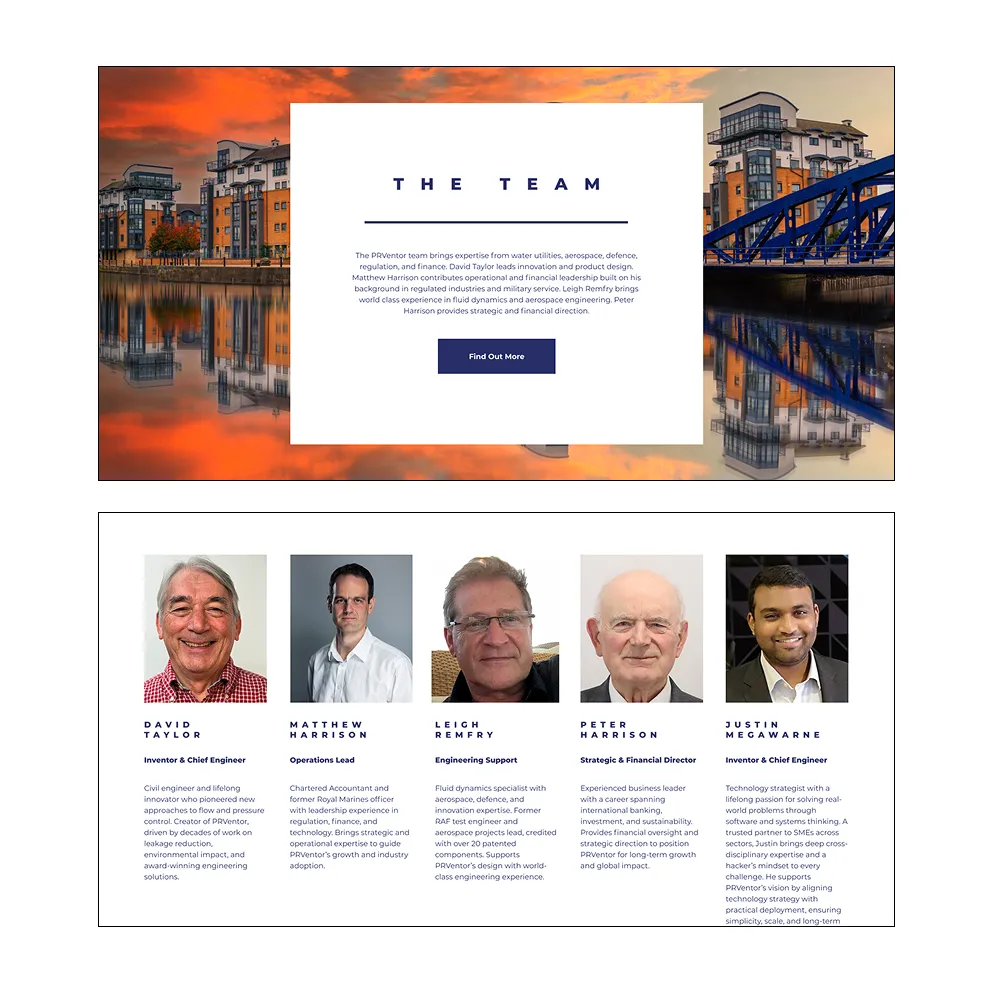
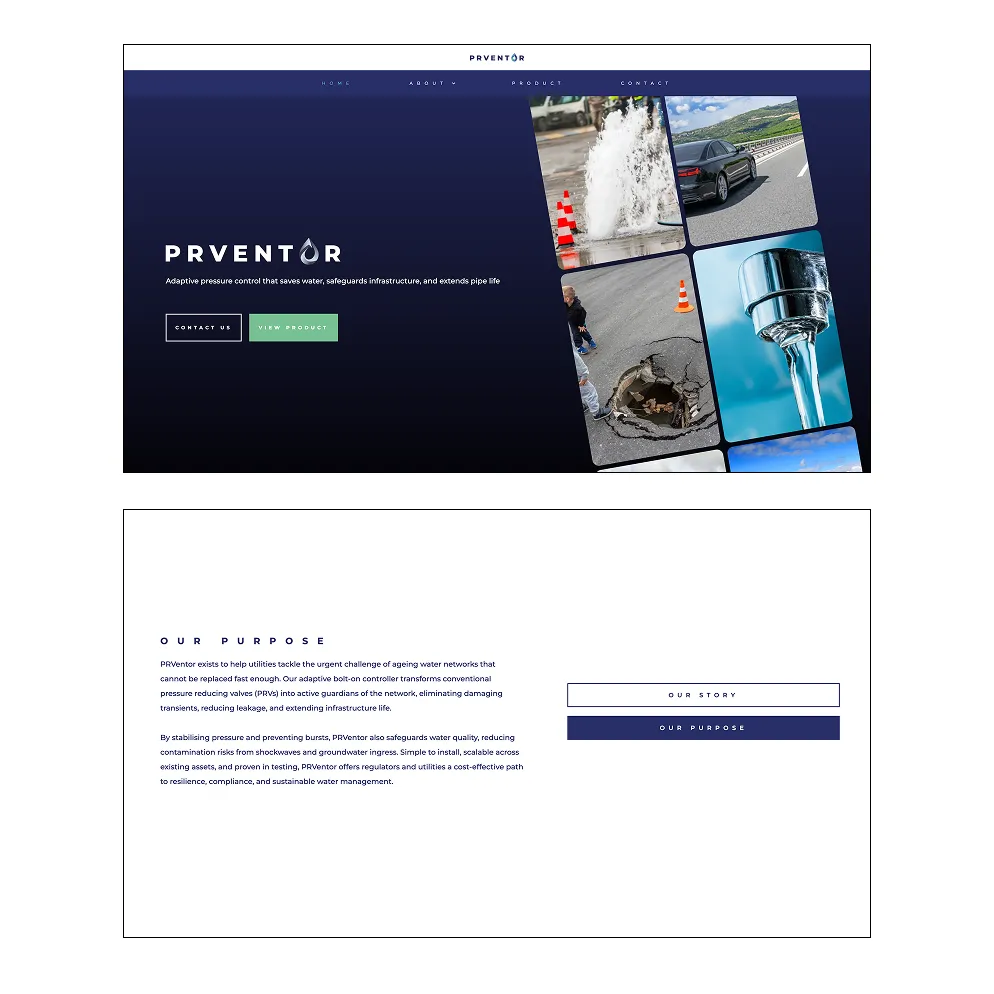
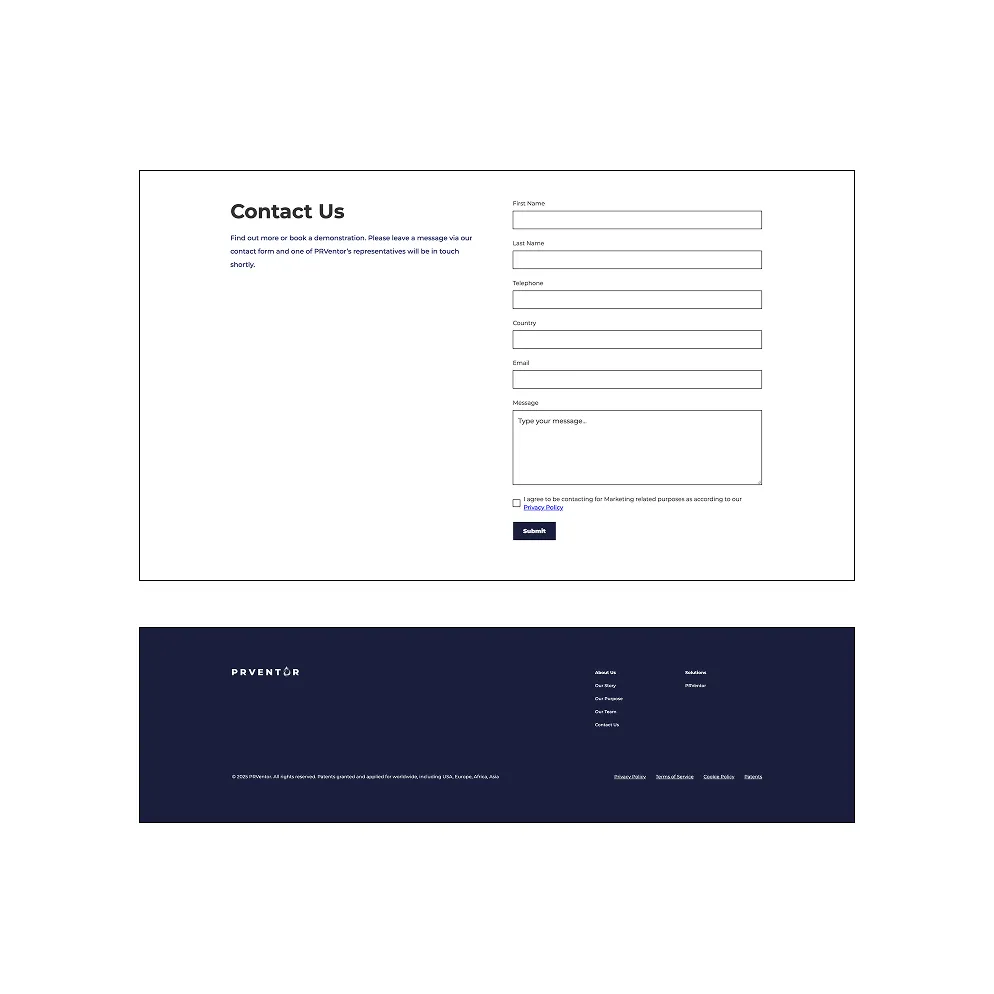
We were approached by PRVentor, an innovative water technology company helping utilities tackle the urgent challenge of ageing water networks that cannot be replaced fast enough. Their adaptive bolt-on controller transforms conventional pressure reducing valves into active guardians of the network, reducing leakage, preventing bursts and extending infrastructure life. We committed to helping PRVentor by designing their brand identity and developing a Webflow website to clearly communicate their technology to utilities and regulators. Our engagement spanned 12 weeks, during which our team worked to translate a highly technical product into a brand that feels credible, clear and ready for market.
%204.webp)
As PRVentor prepared to bring a highly technical product to market, we found it crucial to translate complex engineering into a brand that utilities and regulators could quickly understand and trust. With no existing identity to build on, we created the brand from scratch, defining how PRVentor should look, sound and feel from the ground up. By understanding the company's vision, the technology behind it and the perspectives of its different stakeholders, we were able to guide the team towards a clear, shared direction that benefited both the business and the brand.
Through our initial consultations, we understood that a strong brand identity, clear communication of the technology and a well-executed website would play a pivotal role in how PRVentor engaged utilities and regulators.
PRVentor's product is highly technical, and the website needed to explain it to engineers, utility leaders and regulators alike. Our challenge was to distil complex concepts, from pressure transients to infrastructure life, into clear messaging and visuals. We gave each audience the depth they need without overwhelming those looking for the bigger picture.
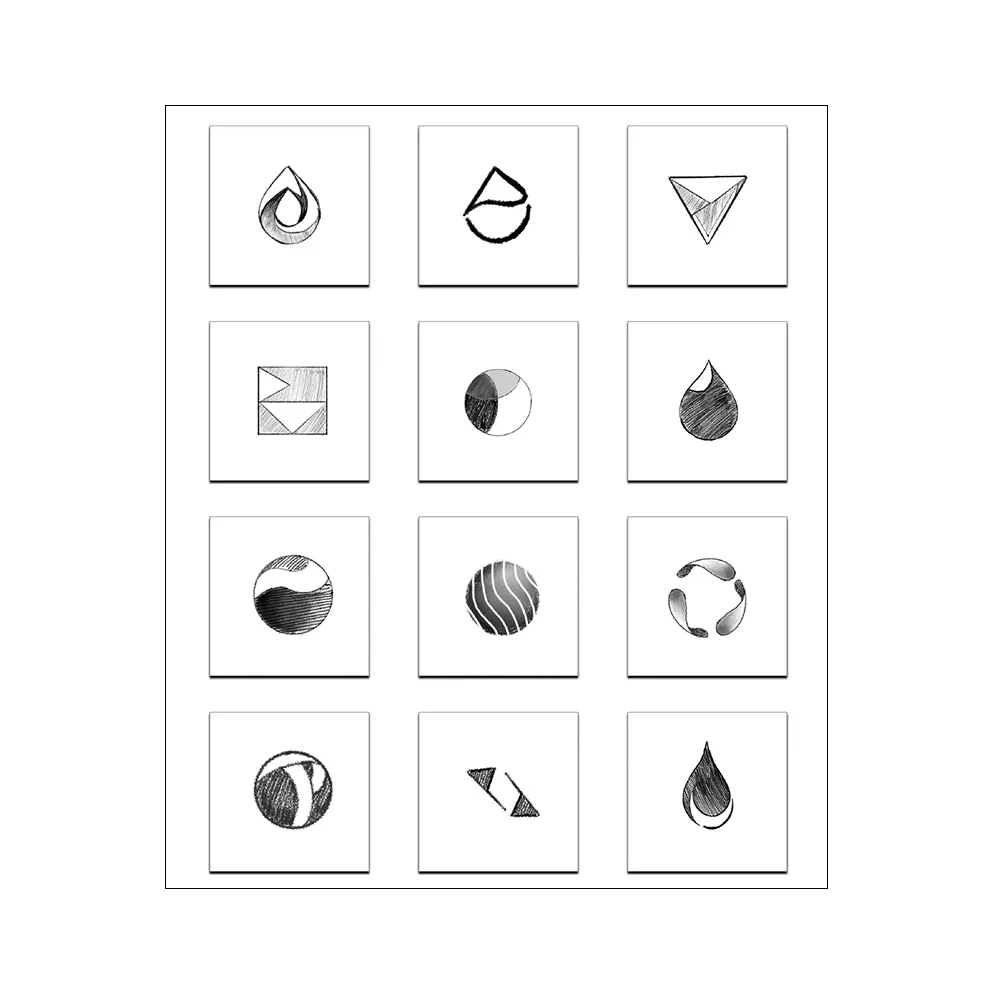
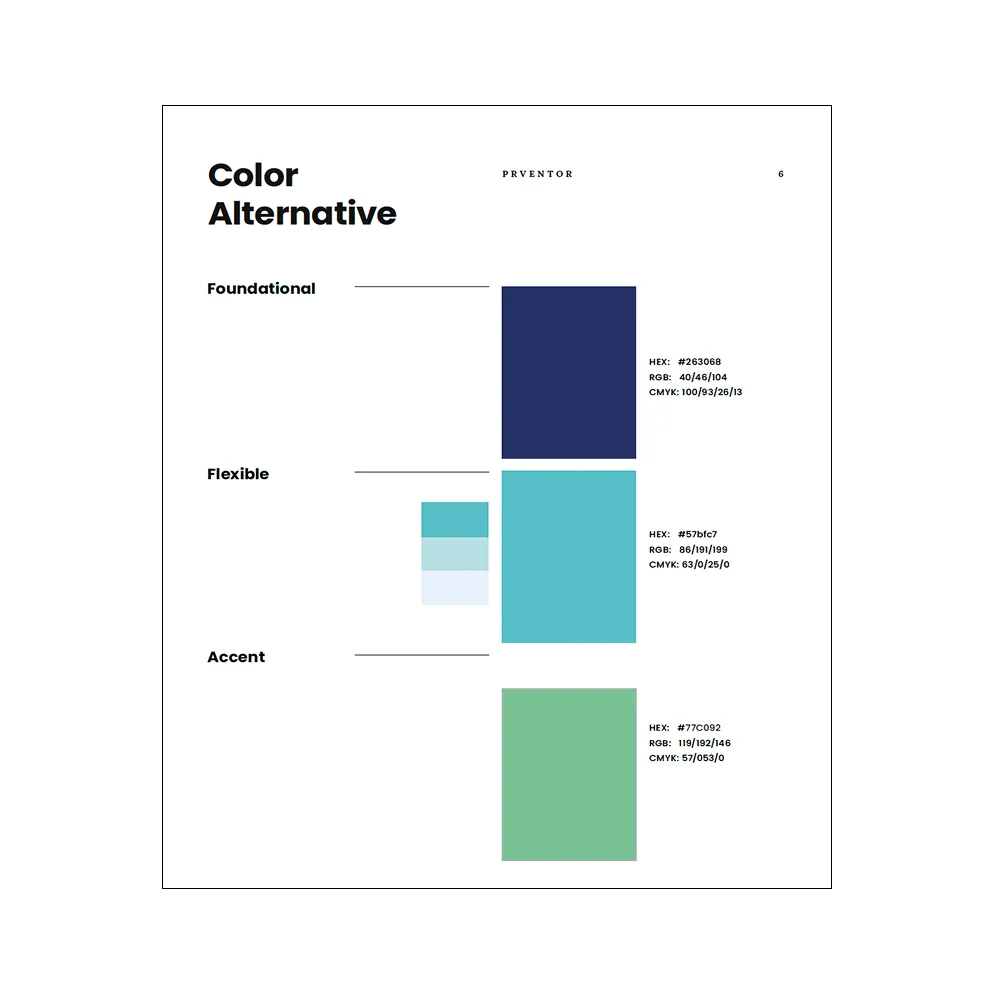
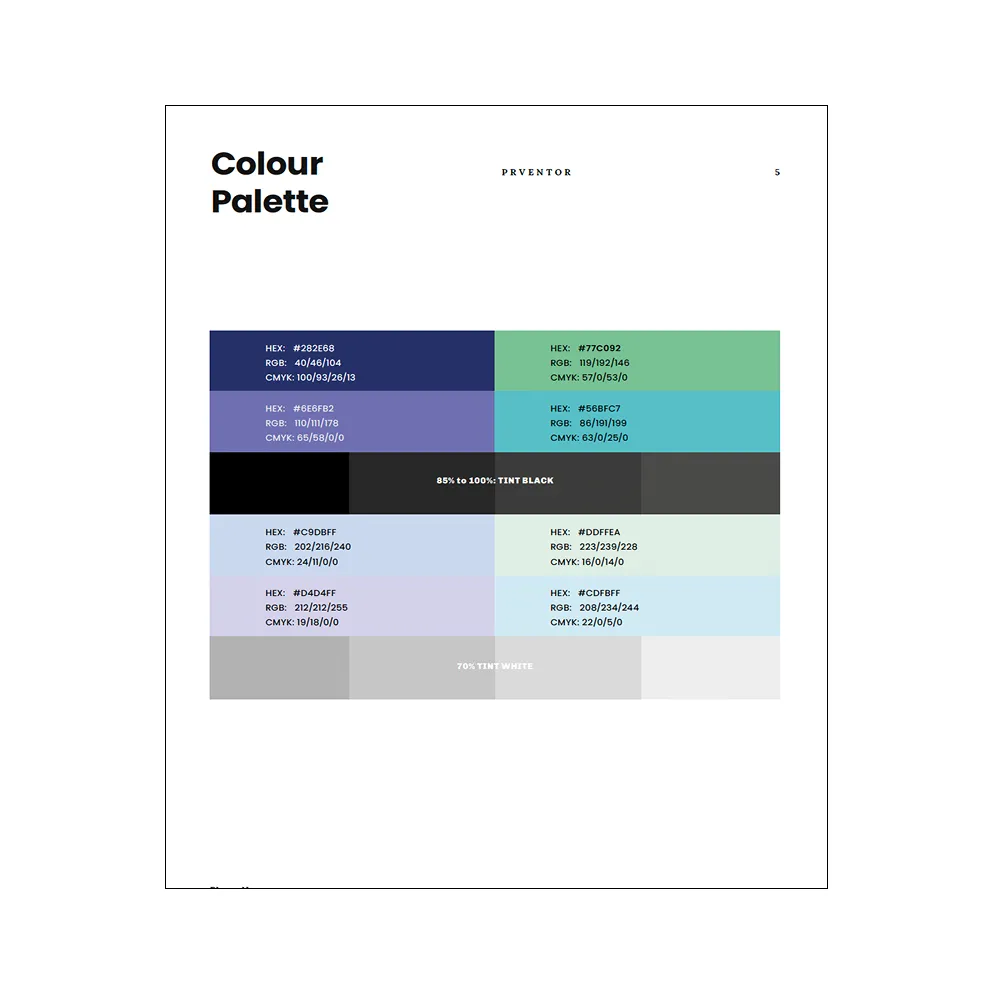
With no existing brand to build on, our first challenge was to create an identity suited to the water utility market. The sector values trust, reliability and technical credibility, so the brand needed to feel dependable while still signalling innovation. We developed an identity that positions PRVentor as forward-thinking without losing the seriousness its audience expects.
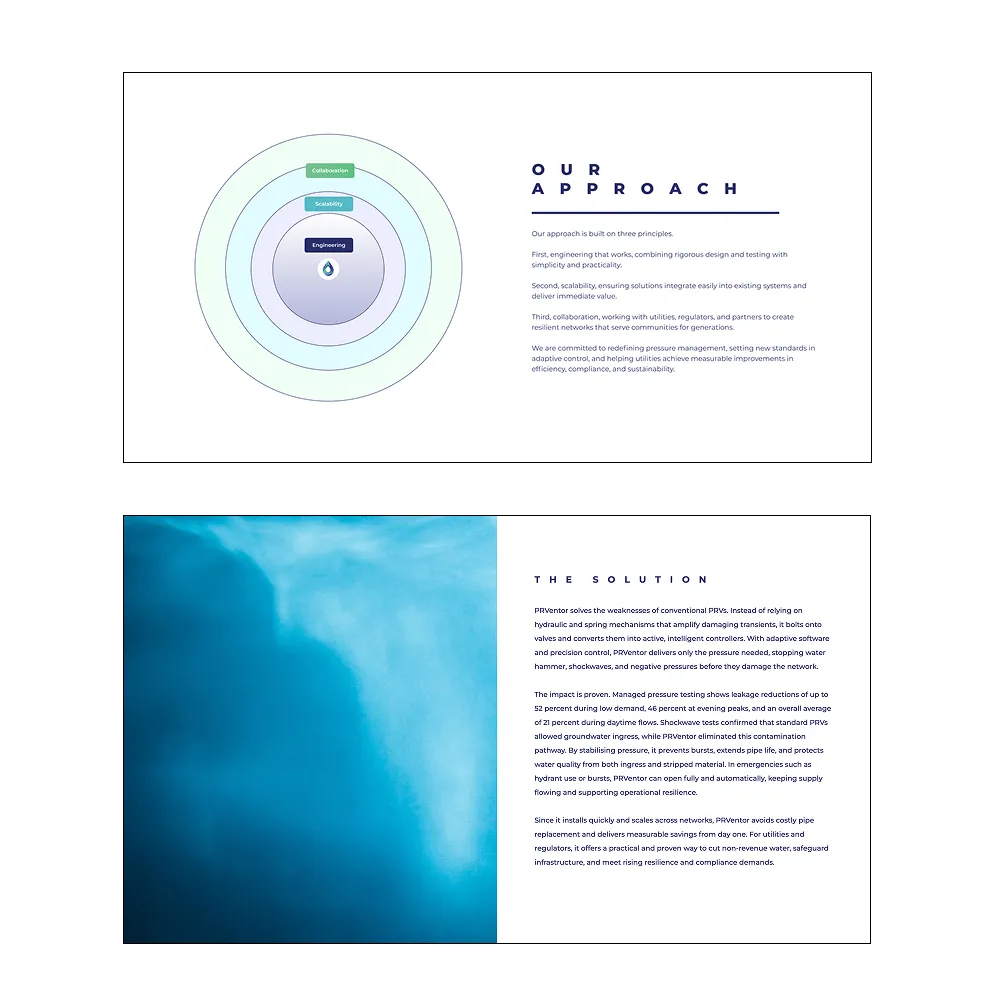
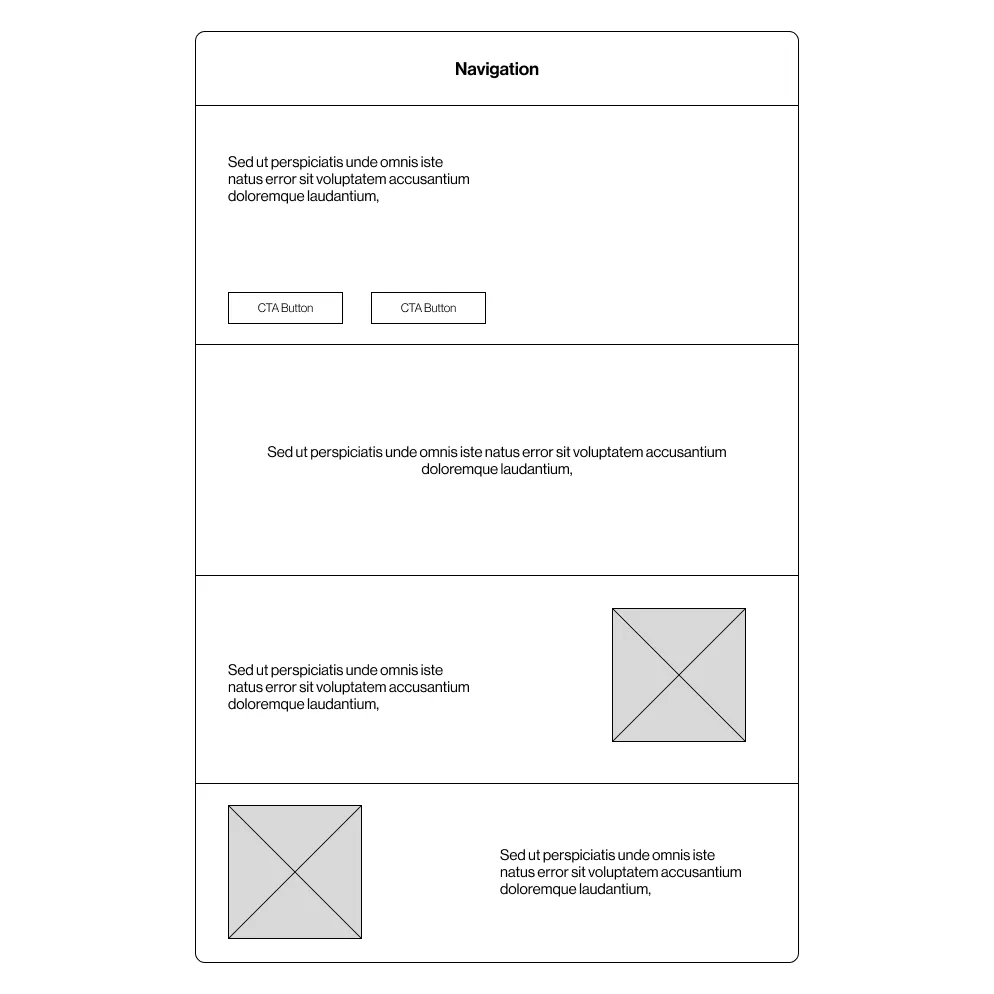
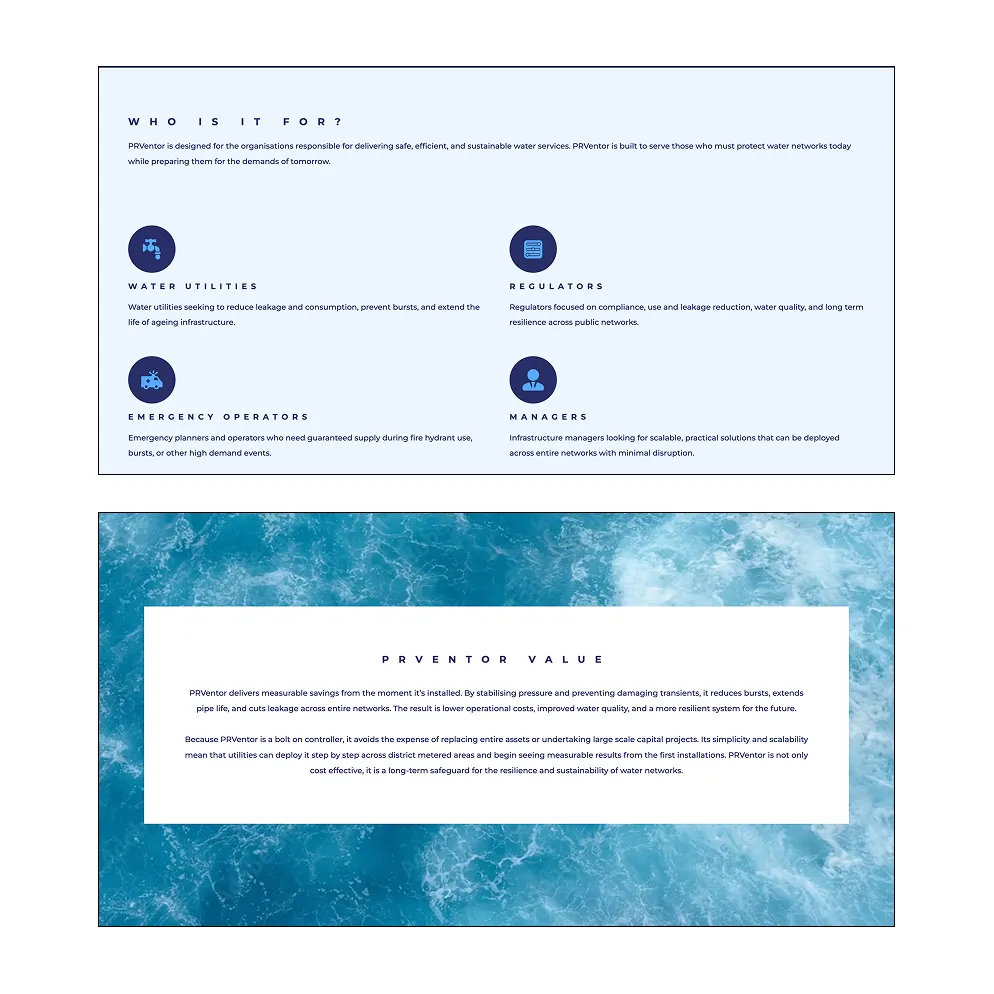
With the brand and messaging in place, the final challenge was to bring everything together in a fully functional Webflow website. We designed and developed a responsive site that showcases the technology clearly and scales as PRVentor grows. The result is a platform ready to support the company as it engages utilities and regulators.
As PRVentor was preparing to enter the market, we drew on the team's deep industry knowledge and testing experience to build a clear picture of who the brand and website needed to reach. Through one-to-one interviews with the founders and key stakeholders, we explored the priorities, pressures and decision-making processes of water utilities and regulators. These insights shaped a set of personas and empathy maps, which helped us to:
- Shape design choices for a brand identity that feels credible and dependable within the water industry.
- Define clear value propositions around leakage reduction, infrastructure protection and water quality for each audience.
- Inform the website's user experience, structuring technical content so engineers, utility leaders and regulators can each find what matters to them.
Guide how the technology is visualised, making complex concepts like pressure transients easy to grasp at a glance.


Joanne is Director of Water Networks at a large English water utility, accountable for the performance of thousands of kilometres of ageing pipework.
Joanne wants to turn around her network's performance on bursts, leakage and supply interruptions at a time when the industry is under intense public scrutiny. Restoring customer and public trust is as important to her as hitting the numbers.
Joanne is shaped by regulatory performance targets, customer complaints and the headlines her company makes. She relies heavily on the judgement of her regional network managers and the operational data they bring her.
She knows the network is ageing faster than it can ever be replaced, and that mains renewal alone won't close the gap. Promising technologies too often stall in trials while the problems on the ground keep growing.
Joanne is calm under pressure, accountable and people-focused. She leads from the front during incidents and has little time for solutions that can't show how they'll work across her existing assets.
Joanne's days are back-to-back meetings, so she works mostly from her phone and an iPad. She reviews performance dashboards daily but leaves detailed technical analysis to her teams.
Joanne responds to a concise, confident narrative backed by clear outcomes. She wants to see quickly how a solution works with infrastructure already in the ground and what difference it makes to performance.

Ravi is a Partner at a climate technology venture fund, specialising in water and infrastructure investments.
Ravi is looking to back hardware-enabled water technologies with the potential to scale across global networks. He's searching for companies solving urgent, expensive problems in markets with strong regulatory momentum.
Market size, the strength of the founding team, defensible IP and early utility traction all shape his decisions. He also pays close attention to which co-investors and industry partners are already involved.
Ravi sees too many water startups that pitch the technology rather than the market. Long utility sales cycles make him wary of companies without a clear route to adoption and revenue.
Ravi is sharp, curious and quick to spot patterns. He decides early what not to pursue, but when an opportunity excites him, he moves fast and goes deep.
Ravi is a power user who works from a MacBook and relies on deal-flow platforms, market databases and a CRM to track opportunities. He often forms a first impression from a company's website before a pitch deck arrives.
Ravi is drawn to brands that signal ambition and global potential. He wants a website that tells a clear story of problem, product, proof and market, and that makes the company look investable from the first scroll.

Fiona is a Principal Water Quality Scientist at a Scottish water utility, investigating the causes of contamination incidents across the distribution network.
Fiona's priority is reducing contamination risk in the network. She's increasingly focused on the link between pressure events and groundwater ingress, and on finding ways to prevent incidents rather than investigate them after the fact.
Peer-reviewed research, laboratory data and the findings of her own incident investigations guide her thinking. She places great value on scientific rigour and transparent methodology.
Fiona is frustrated that water quality is often treated as an afterthought in conversations dominated by leakage and cost. In her view, pressure stability is as much a public health issue as an engineering one.
Fiona is meticulous, principled and quietly persistent. She rarely speaks first in meetings, but when she does, people listen, and she won't endorse anything she hasn't scrutinised thoroughly.
Fiona works with laboratory information systems and sampling databases daily. She prefers to print longer documents and annotate them by hand before forming a view.
Fiona favours substance over style, with detailed technical information, references and supporting data easy to find. Generic stock imagery of splashing water immediately undermines credibility for her.

Thinks
"If we can stabilise pressure, we can buy years of life from these mains."
"Will my regional managers back this once they've seen it?"
"We need to be seen to be acting, not just planning."
Does
Joanne asks her regional managers where bursts and interruptions are concentrated before considering any new intervention.
She visits sites after major incidents to understand what happened and what her teams need.
She champions initiatives that show visible, measurable improvement in network performance and customer experience.
Says
"We can't dig our way out of this problem."
"How does this work with the valves we already have in the ground?"
"Our customers deserve a network they can rely on."
Feels
Joanne feels the weight of leading a network that is under public scrutiny like never before, where every burst can become a headline. She's proud of her teams and determined to show real progress, but frustrated by the scale of the challenge compared to the pace of renewal. A solution that improves performance using existing assets would give her something rare: a quick win that lasts.

Thinks
"A bolt-on solution for existing assets could scale much faster than replacement."
"Is the IP strong enough to defend this position?"
"Which utilities are already engaged, and how serious are they?"
Does
Ravi reviews a company's website, founders' backgrounds and market positioning before agreeing to an introductory call.
He speaks with utility contacts in his network to test whether a problem is felt as urgently as founders claim.
He builds an investment thesis around market size, regulatory drivers and route to scale before taking an opportunity to his partners.
Says
"How big is this problem globally, not just in the UK?"
"What's stopping a utility from adopting this tomorrow?"
"Tell me about the team behind it."
Feels
Ravi feels energised by the scale of the opportunity in water infrastructure, a sector he believes is long overdue for innovation. He's also cautious, having seen promising technologies stall because of slow procurement and conservative buyers. That makes him excited by companies that pair strong technology with a credible plan for getting it adopted.

Thinks
"Does stabilising pressure measurably reduce ingress risk?"
"Has this been tested under conditions that reflect our network?"
"Why isn't water quality part of this conversation more often?"
Does
Fiona reads technical papers and test reports in full, annotating them before discussing findings with colleagues.
She cross-references new claims against her own incident data to look for patterns and gaps.
She raises water quality considerations in cross-departmental discussions, ensuring they shape decisions on network investment.
Says
"Pressure transients are a water quality issue, not just a leakage one."
"I'd like to see the methodology behind those results."
"Prevention is always preferable to investigation."
Feels
Fiona feels a quiet but profound duty to protect the public, knowing the consequences of contamination can be serious and far-reaching. She's encouraged when new technology addresses root causes, yet weary of claims that don't hold up under scientific scrutiny. That makes her slow to trust but loyal once a solution has earned it.


Working with PRVentor was a rewarding experience from the very beginning. The team's passion for solving one of the water industry's most pressing challenges was infectious, and it pushed us to bring our best thinking to every stage of the project. Building a brand from the ground up for such a technical product gave us the opportunity to dive deep into a new sector and find clarity in complexity. We're proud to have played a part in shaping how PRVentor presents itself to utilities, regulators and investors as it prepares for its next stage of growth.